Kosciusko native forecasts and experiences the ravages of Hurricane Laura
Kosciusko native Ben Terry, a weatherman at KPLC in Lake Charles, Louisiana, recently lived through Category 4 Hurricane Laura, probably the toughest experience in both his professional and personal life.
“It changed this area forever,” Terry said of Laura. Previously, the southwest Louisiana area had most recently been devastated by Hurricane Rita in 2005. Occurring three weeks after Hurricane Katrina, Rita was probably the “forgotten” storm of that hurricane season. As Laura 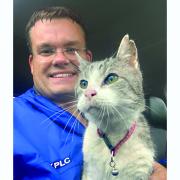 approached, however, Terry warned his viewers that damage from this storm would be worse. Unlike Rita, which weakened as it approached landfall, Laura was intensifying.
“I knew it had the potential to cause exponentially more damage than Rita, and I had to get on the air and tell people to get out,” Terry said.
As it turned out, Terry was right. The city of Lake Charles had approximately 85% of its structures damaged, everything from roof leaks all the way to total losses.
“I kept telling people to get out and not to put their families through this,” he said. “I also told them to take pictures before they left because I knew that Lake Charles would never look this way again.”
Heeding his own advice, Terry took a photo of his own home, which Laura rendered a total loss.
Despite concerns about his home, however, Terry’s main worry was the well-being of his cat, Vincent, whom he left in his home when he evacuated to Baton Rouge the day before the storm. Luckily, Vincent made it through with only a few bruises and he is now staying in Kosciusko with Terry’s parents, Jimmy and Kathy Rone.
Terry surveyed Lake Charles after Laura had passed.
“It looked like a bomb had been dropped. Unlike a tornado, which has a path, everything in the area was touched by Laura in some way,” he said.
Thankfully, help has arrived.
“Unlike what some national news reports are saying, this is not a forgotten area. Help is coming from all over the country with contractors, linemen, Joyce Meyer, the Southern Baptist Convention and many others. The Tide Loads of Hope truck is here in the Walmart parking lot, helping people get their clothes washed. People can get fed because tents serving meals are set up almost anywhere you look,” Terry said of the support received by the residents of Lake Charles. “The president and several senators have come to the area. The National Guard and local law enforcement are out doing all that they can to help others.”
With all the traffic back and forth to Baton Rouge, that vital route has slowed.
“The drive to Baton Rouge now takes about three to four hours instead of two due to the traffic coming in and out of Lake Charles, as well as the damaged roadways,” Terry said.
With all the help received, he said the area has reopened faster that it did after Rita.
“Some stores have even reopened, such as Lowe’s and Home Depot, so that people can get tarps and other necessities,” he said.
No deaths have been reported as a direct result of the storm, but some have died in relation to the circumstances Laura created.
“We have had several deaths due to heat-related illnesses. There are heat advisories out, and someone might be working on his roof alone and have a heat stroke and can’t get to the phone. There are also hazards all around, such as snakes and debris,” Terry said.
But the saddest thing to Terry has been the deaths due to carbon monoxide poisoning because people are using generators improperly.
“People are setting up generators in their garages or even in their homes. Recently, a family of five died of carbon monoxide poisoning. These types of tragedies are hard to swallow,” he said.
While Lake Charles is doing better than many might expect under the circumstances, Terry said there are still difficult challenges for area residents.
“It is still very dangerous to head into Lake Charles,” he said. “We were almost a week without water, and that becomes a humanitarian issue. Luckily, we have water back now and many of the roads are getting cleared.”
With a mandatory evacuation in place for the city, residents are allowed in during the day to check on their properties and begin clean up, but they must leave by nightfall.
As for KPLC, the Lake Charles television station where Terry works, he said he is glad he and his co-workers evacuated instead of staying and trying to broadcast from the station as Laura arrived.
“The tower fell right into the studio where we would have been broadcasting from. Several of us had some PTSD (post-traumatic stress disorder) upon realizing that we almost stayed and it would have come down right on us,” he said.
The station is currently broadcasting from Baton Rouge, and it will take months to return to normal. Because the main transmitter was not damaged, Terry hopes the signal will be back soon so regular broadcasts can resume.
The road to Lake Charles
The son of the Rones and Jack and Gail Terry of Madison, MS, Terry said he was always interested in the weather and liked to watch forecasts as a child. A graduate of Kosciusko High School and Holmes Community College, Terry majored in Broadcast Meteorology at Mississippi State and graduated in 2006, the year after Hurricanes Katrina and Rita.
“It was an easy decision. I liked that a college close to home had the program that I was interested in,” Terry said.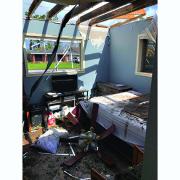
He took his first job at a company in Jackson called Weather Vision, where he remained for five years. Upon the recommendation of Barbie Bassett of WLBT, Terry applied for a couple of meteorologist jobs in Louisiana, and was eventually hired by KPLC in Lake Charles as the Morning Show weatherman.
“That was over nine years ago. The people there welcomed me with open arms. I fell in love with the Morning Show format, and I enjoy working with all of my co-anchors,” Terry said.
Despite the personal impact of Laura on his own life, Terry’s heart goes out to others.
“I am thankful that I evacuated. A lot of people didn’t and it’s been really tough on them,” he said. “But the people in this area are strong, and they are going to rebuild.”