Jim Abbott wasn’t planning on a book when he began writing his life’s story. But with the encouragement of family and friends, including a book publisher, the result is a fascinating 300-page memoir that launches Tuesday and brings the Greenwood native and former longtime weekly newspaper editor to his hometown two days later for a book signing.
The book, “Paper Man: Chasing the Truth in the Mississippi Delta,” began as a personal genealogy project, the 82-year-old Abbott recalled.
“At some point, I started realizing how much I wished that my great-grandparents had written memoirs. And then I started thinking, ‘Well, you know, I have five grandchildren. I bet they would like someday to read what Pop Pop did in his life.’ And I literally looked over at my laptop, and I was like, ‘I could do that. I can write.’ So that's what started it, and that was like two and a half or three years ago.”
Although the majority of the book is filled with the important, dramatic and sometimes wacky news that Abbott and his small newsroom at The Enterprise-Tocsin covered during his 38 years at its helm, it’s also a study in the transformation of racial attitudes that occurred in Mississippi during Abbott’s lifetime and also within the author himself.
The book opens with Abbott’s firsthand recollection of one of the most traumatic episodes in Mississippi’s troubled civil rights history: the enrollment of James Meredith as the first Black student at the University of Mississippi.
Abbott was a freshman that fall in 1962 when Meredith’s arrival prompted a riot that resulted in two deaths, hundreds of injuries and the deployment of federal troops by President John F. Kennedy. Abbott acknowledges that, with bullets flying and tear gas floating through the Oxford campus, he was not sympathetic to Meredith, nor was he fond of Kennedy, who would be assassinated 14 months later.
“It was painful for me to recall all of that because it’s embarrassing to me what my feelings were at that time,” he said.
Gradually, though, over the next several years, his racial perspective changed. Abbott, the product of a heavily segregated town, witnessed the mistreatment by white authorities of Black residents and the civil rights workers who helped them register to vote; he felt the charisma of Kennedy’s brother, Robert F. Kennedy, during a speech at Ole Miss less than four years after the rioting; and he interacted with Black soldiers while being deployed during the Vietnam War.
Among a series of epiphanies he experienced, most searing might have been the time, while working in California during a summer break from college, he was waiting for the red light to change at a San Francisco crosswalk as a group of pedestrians hurried across.
“Lagging behind was one elderly, sweet-looking White lady pulling her little shopping cart,” Abbott writes in his memoir. “As she walked nearer to my Chevrolet coupe, I noticed she looked down at my front ‘Ole Miss’ license plate. She stopped, looked up at me, and spit on the pavement in front of my car. … The woman gave me one final, menacing scowl and walked on. My face was red. The light turned green. I stepped on the accelerator and moved forward. Also advancing was my 21-year-old Mississippi mind. The incident was a shocking realization of how reviled our state — and my university — were among certain Americans.”
- - -
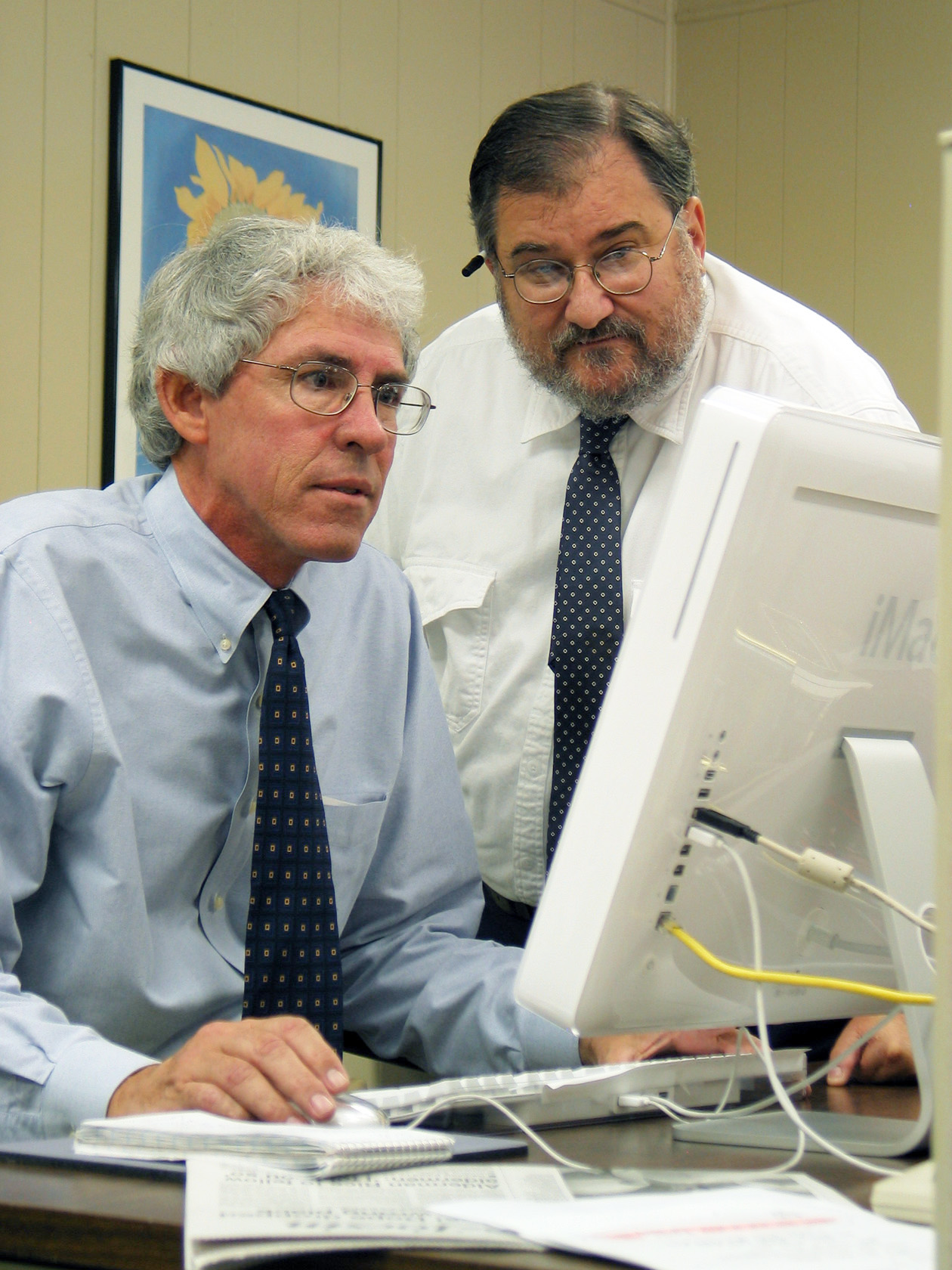 In this undated photo, Jim Abbott, left, works on a story at The Enterprise-Tocsin with the assistance of his longtime newsroom colleague, David Rushing. (Submitted photo)
When Abbott arrived in Indianola five years later, the first-time editor was ready to start shaping a Delta community for the better through the newspaper of which he was put in charge.
At his side was his wife, Cynthia, his sweetheart since their time together at Greenwood High School. She did not plan initially to work at the newspaper. Her background was in elementary education. Eventually, though, Jim coaxed her out of the classroom, and over the next 30 years she took on various roles on the business side of the newspaper while also serving as “kind of the mother hen for our staff,” Jim said.
Prior to his arrival in July 1970, The Enterprise-Tocsin, founded in 1888, was “a mediocre publication at best,” Abbott writes. As so many Mississippi newspapers did at the time, it catered mostly to the white segment of the community. Blacks largely only made the paper if they had been arrested. “So, I immediately started having a more balanced newspaper as far as covering the community,” he said.
He got some pushback from whites, but it never rose to the level where he felt physically endangered or economically threatened. Even though Abbott did not acquire half-ownership of the paper until 1981, he was allowed to run the paper as if he did, having the freedom to decide what stories the newspaper would cover and how it would cover them.
“There was some really good leadership in town, and some progressives,” he said.
In the process, he transformed The Enterprise-Tocsin into one of the best weekly newspapers in the state.
A perfectionist by nature, Abbott was so concerned about the newspaper’s photographs — for which it won many Mississippi Press Association awards — that most every Wednesday night he would plant himself in the pressroom of The Greenwood Commonwealth, where his paper was printed, and look over the shoulders of the press crew until it got the ink and water balance to his liking.
Several of those photos are sprinkled throughout the book, including one of Abbott himself in the local emergency room after being bitten and scratched around his face and neck by the irate mother of a teenager whom Abbott had caught stealing copies of the newspaper out of a vending machine.
One photograph in the memoir that Abbott did not shoot but rather acquired is expected to be of particular interest to civil rights historians, according to Neil White, owner of The Nautilus Publishing Co. in Oxford, the publisher of Abbott’s memoir. Abbott discovered the framed black-and-white photo in the early 1970s while given permission to look through an old filing cabinet at the local Chevrolet dealership. Posing in the group photo are the members who in 1954 attended the first-ever meeting of the White Citizens’ Council. The Citizens’ Council developed into a national network of middle- and upper-class whites whose mission was to resist the desegregation of the public schools and other institutions, mostly through nonviolent intimidation.
The historic photograph has rarely been seen before. It’s not on display at the Mississippi Civil Rights Museum in Jackson, nor is it in the rest of the collection of the state Department of Archives and History, according to Abbott. In fact, he is aware of only one other place, an academic publication, in which the photo appears.
All of the white men pictured were identified on the back of the photo. Many of them have children or grandchildren still living in the Indianola area. Abbott, who has resided in Oxford with his wife for the past decade, worries that resurrecting the ignominious history might aggravate some readers, particularly in his former Delta home.
“But you know, most of the people in Indianola are really nice people, and I think they understand and understood that we were producing fair journalism.
“It’s bothersome that I had to point out that Indianola was the birthplace of the White Citizens’ Council. … Some people would like to just erase that from the town's history, but I couldn't ignore it.”
During the years in which Abbott was writing his memoir, he chose to do most of his work at the dining room table on the first floor of his home rather than a large room upstairs, where he has two desktop computers set up.
“I just wanted to be down here where Cynthia is and where the food is and where the nice porch is. It’s just I like being down here, downstairs. So, I took over this dining room to Cynthia’s dismay,” he said.
Most of the books, papers, photographs and sticky notes have now been cleared away from that spot. Cynthia might not rest easy, however.
Her husband said he still has at least one major publishing project left in him. An admitted pack rat, he has saved thousands and thousands of 35-millimeter negatives, mostly black and white, that he or other members of The Enterprise-Tocsin staff shot from 1970 until his retirement in 2008. He plans to electronically scan the best photos and publish them in a book for posterity.
“I feel like I need to do that,” he said.
- Contact Tim Kalich at tkalich@gwcommonwealth.com or 662-208-4935.
CLICK HERE for book signings schedule