Winter Storm Fern coated Grenada County and much of north Mississippi in a thick layer of ice last weekend, uprooting trees, snapping limbs and loading down power lines and poles, leaving thousands of Entergy Mississippi customers in the dark for days.
Five days after the storm, many residents remain without electricity as Entergy crews continued working across the region. On Thursday afternoon, Entergy Mississippi CEO Haley Fisackerly visited Grenada to view storm damage after earlier stops in Lexington in Holmes County and Winona in Montgomery County, and prior to heading to Charleston in Tallahatchie County, meeting with city leaders and taking time out for a video interview with The Grenada Star’s Publisher Adam Prestridge on the Downtown Square.
Below is a transcript of Prestridge and Fisackerly's conversation:
Prestridge: I’m here with Entergy CEO Haley Fisackerly. He’s in Grenada today and just got through speaking with the mayor (Charles Latham) and the City Manager Dr. Trina George. Tell me a little bit about y’all’s conversation and what y’all talked about.
Fisackerly: Yeah, so I’m glad to be in Grenada today. We’re meeting with the mayor and other city officials to update them on the restoration process that’s happening in Grenada and the surrounding areas. And we also took the opportunity to listen to some of their concerns, and so it was good feedback that we’ll take back and share with our crews.
We’re making great progress. At the peak of the storm, we had 67,000 customers out across our service territory that stretches from DeSoto County all the way to Adams County, and we saw outages there. We had as many as 83,000 have outages, and about 60,000 have been restored, and we’re now in the hardest-hit areas. As far as Entergy Mississippi, Grenada is ground zero for us and the areas around that, so this is where most of our work is concentrated now to get customers in Grenada and in the areas around it back up.
Prestridge: Are you able to share any of the concerns the city might have had?
Fisackerly: Oh, they were just asking – for example – [about] the power to the lift stations and stuff. We’re going to check that out. And – for example – a lot of people can get confused, like that neighborhood’s on, why isn’t my neighborhood on? Or my neighbor across the street is on, why aren’t I on? And so we took time to explain to them how a system is built and how we have trunk lines and feeders that come off of those, and some feeders will come on first before others, but they can be different ones. So we were walking them through that restoration process.
Prestridge: Well, that leads into my next question. How are restoration priorities determined?
Fisackerly: Yeah, so we have a very proven, methodical process. So, when the storm hits, we first move damage assessors in. They come in and examine the areas. And one of the problems that you saw in this area – roads were blocked by ice and vegetation and stuff, but still, we have to come in and assess the damage. Once that is assessed, then we have to go all the way back to the power source – the substations – to start restoring lines back into the area.
We first focus on those circuits that serve hospitals, first responders. Then, we focus on essential services, and then the lines that get the most customers on as quickly as possible. And the reason why is that’s the most productive and efficient way to get them on. Then it comes to the hardest circuits. As you get into neighborhoods and into rural areas, that circuit may – you may have to put four poles on to get two or three people on, and that’s what we’re into is getting into those hard-to-reach areas. It’s very scattered all the way around here, down to Winona, Lexington, up to Charleston and the area. This was where the meat of that ice band was – as you know – that, of course, took a turn up into Oxford.
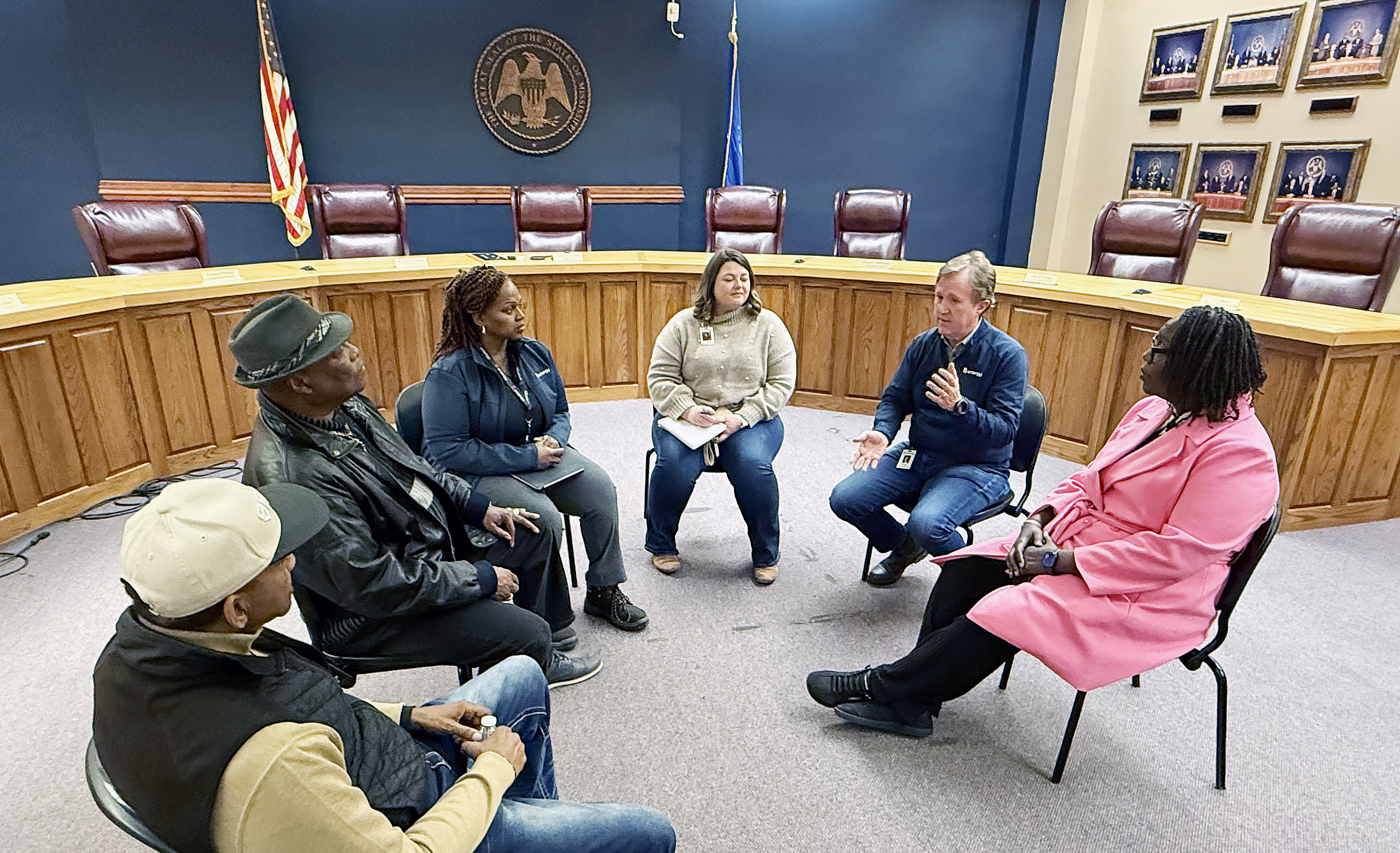 Entergy Mississippi CEO Haley Fisackerly and his team meet with City of Grenada officials, from left, Ward 3 City Councilman Lewis Johnson, Mayor Charles H. Latham and City Manager Dr. Trina George at City Hall during his visit to Grenada Thursday afternoon. | Photo by Adam Prestridge © 2026 Emmerich Newspapers, Inc.
Prestridge: Yes, you all typically, you have crews come in and try to get the heart of the city so people have essential services.
Fisackerly: Essential services. You want to get grocery stores back up; gas stations, people need fuel. The hospitals and first responders are first, then essential services. What do people need to have there?
Now, what is interesting about this storm, we had a lot of transmission damage. We had over 23 substations that were put out of service. They’ve all been restored. We had 30-something transmission line segments out, so they power the substations. So even if the lines were up, the distributions that serve homes and businesses, we had to get those restored. We had 2 inches of ice in some of these substations up in this area, and that really created a problem. Now we’re focused on the distribution side, and just walking – just before I got talking to you – we’re now approaching close to 1,000 broken poles replaced and over 165 miles of span wire down. And hundreds of transformers have to be replaced. It’s amounting to be one of our most costly storms we’ve seen in some time.
Prestridge: So a lot of the failures that typically would occur, y’all have been thrown some curve balls.
Fisackerly: Oh, yeah, thrown some curve balls. I was in the Delta the other day, went around Hollandale where they were reporting – we were seeing ice on lines in excess of an inch there, and that will make anything fail. That’s a lot of weight on the circuits.
Prestridge: So how many Entergy crews are actually out working, and how many from out of state, how many states? You know, are you able to tell, give us a little bit of that?
Fisackerly: So we have a total workforce of over 2,800 people on the ground. Those are crews including our crews and plus what we have brought on board. They are coming from 20 states and Canada. So, I was just visiting with crews from Colorado down in Lexington, a group from Kentucky, and the other day I was visiting with a group out of Ontario, Canada, and out of New York. So, we have brought them from everywhere.
This storm, when it hit, that system ran from New Mexico all the way to the Northeast. And so one of the challenges on the front end was a lot of workers were locked down to their native areas. Our incident command has a very proven process, so we were able to move quickly and get our resources in here. So, people ask, why don’t you get more workers? Well, we have to bed them, we have to feed them.
So, we had to set up four strategic base camps. One’s here in Grenada, south of town; one up in Batesville; one over in Greenville, and then down in Lexington we have a huge laydown yard where all the equipment’s being brought in – poles, wire – you name it – that’s being done. And then there’s hundreds of people behind the scenes that are having to plan out how we’re going to get food in there, how do we refuel the trucks, how do we reequip them. It’s like moving an army.
Prestridge: Yeah, how big of a blessing is it to have something like Camp McCain? I mean, I’ve been out there and it looks like another city inside of a city. How much has that been, you know, a blessing to be able to utilize that?
Fisackerly: Whenever you can find space like that because you’re moving trucks, hundreds of trucks, and so, you got to have space to be able to park them and line them up because when they come in at night, there’s people coming in behind them fueling them up, restocking them. So, when they wake up in the morning, they pull out and go.
Prestridge: A lot of people don’t realize there’s fuel out there, there’s equipment, there’s poles, there’s catering, I mean there’s food, bathrooms, showers. I mean, it’s amazing. Well, last question, might be the hardest question. What should people expect in the next couple of days? It’s been five days. Y’all gave, I guess, an estimate at the very beginning of the week. Entergy said, what, 9 p.m. on Sunday, February 1st, is that…
Fisackerly: I got to stop and think what day it is. I’ve been working this thing since [last] Friday. So what is today? Thursday.
Prestridge: It’s Thursday, yes sir.
Fisackerly: OK. So here’s what it is. We got 60,000 customers on today. This last 23,000 is the hard ones to get on, right? This is where the most damage is and then we get into those rural circuits where we like – we call it the onesie-twosies. I’m going to get two poles up and get one customer on, you know, or one mile of line up to get one customer on. That’s part of the business. So, we’re going through that process right now. But we expect to have everybody in the area completed by Sunday.
Prestridge: OK. Well, all right, that’s about all we have. Thank you, Haley, and I appreciate y’all’s crews and everything y’all are doing.
Fisackerly: Great, appreciate it. Thank you for giving a chance to talk to your readers.